
Posterior Spinal Fusion
A procedure to permanently stabilise one or more spinal segments through an approach from the back of the spine — using screws, rods, and bone graft to achieve solid bony union across the fused levels.
Overview
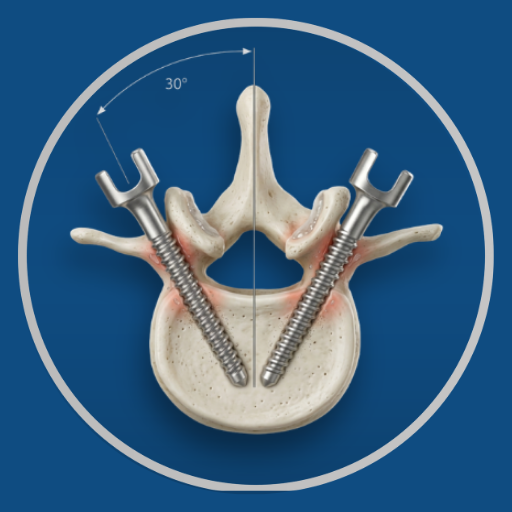
Posterior spinal fusion (PSF) is the foundational stabilisation procedure in spine surgery. It is used across a wide range of indications — degenerative instability, spondylolisthesis, deformity, fracture, and post-decompression instability. The approach is from the back of the spine, allowing direct visualisation of the posterior elements, decompression of neural structures where required, and secure placement of pedicle screw instrumentation. Fusion is achieved through the application of bone graft to the decorticated posterior elements, which stimulates bony union over 6–12 months.
Before Surgery
Imaging review including MRI and standing X-rays. CT for surgical planning where complex instrumentation is anticipated. Medical optimisation. Discussion of fusion levels, expected outcomes, and recovery timeline.
During Surgery
General anaesthesia. The patient is positioned prone (face down). A midline incision exposes the posterior spinal elements at the affected levels. Pedicle screws are placed at each level to be fused, connected by rods contoured to the desired alignment. Decompression of nerve roots or the spinal cord is performed where required. Bone graft is placed posterolaterally to stimulate fusion. The Medtronic StealthStation navigation system guides screw placement. Duration varies by the number of levels: single-level 2–3 hours, multi-level 4–6+ hours.
After Surgery
Hospital stay 3–5 days for straightforward cases, longer for multi-level or complex procedures. Pain management with a multimodal approach. Mobilisation begins day 1.
Recovery
Return to desk work 6–10 weeks. Return to physical activity 3–6 months, guided by imaging confirmation of fusion progress. Physiotherapy throughout the recovery period.
Dr. Viswanath's Approach
Posterior spinal fusion is the framework within which much of the complex surgical work at this practice is performed — deformity correction, stabilisation of spondylolisthesis, and multi-level degenerative disease all involve PSF as the foundation. Navigation is used routinely. The screw placement philosophy prioritises accuracy and security over speed — the quality of the instrumentation directly affects the quality and durability of the fusion.
Medical Disclaimer: This information is provided for educational purposes only and does not constitute medical advice.