
Percutaneous Pedicle Screw Fixation
A minimally invasive technique for placing stabilising screws into the pedicles of the vertebrae through small skin punctures — without opening the spine through a conventional incision.
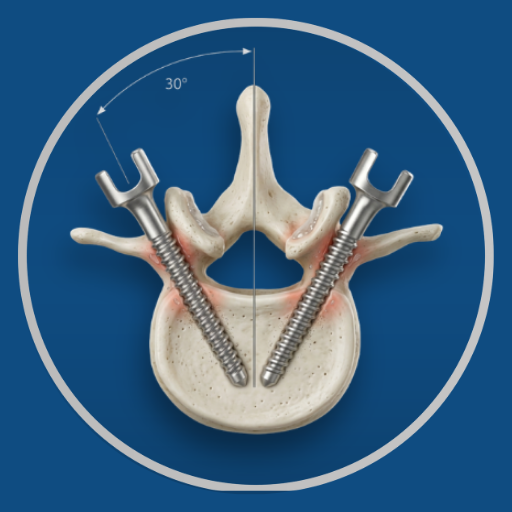
Overview
Percutaneous pedicle screw fixation allows spinal stabilisation to be achieved through small puncture incisions rather than an open approach. Screws are placed through the skin and into the vertebral pedicles under fluoroscopic and navigation guidance, and connected via rods that are passed under the skin between the screw heads. It is used as part of minimally invasive fusion constructs and in certain fracture stabilisation procedures.
Before Surgery
The technique requires clear pre-operative imaging and careful planning of screw trajectories. CT-based navigation planning is performed pre-operatively. Medical fitness assessment and standard blood tests are required.
During Surgery
Performed under general anaesthesia. Small skin punctures (less than 1 cm each) are made at each screw entry point. The Medtronic StealthStation navigation system provides real-time guidance for accurate pedicle screw placement without the need for extensive anatomical exposure. Fluoroscopic confirmation is used throughout. Duration depends on the number of levels being instrumented.
After Surgery
Significantly less post-operative pain than open instrumentation due to muscle preservation. Hospital stay of 2–3 days for most cases. Earlier mobilisation compared to open stabilisation.
Recovery
The recovery advantage of percutaneous fixation over open instrumentation is most pronounced in the first 4–6 weeks. Overall fusion timeline remains the same — 6–12 months for consolidation. Physiotherapy and return-to-activity milestones mirror those for minimally invasive fusion.
Dr. Viswanath's Approach
Navigation-guided percutaneous screw placement is a core component of the minimally invasive approach at this practice. The Medtronic StealthStation system provides the accuracy required for safe pedicle instrumentation through limited exposure — a particularly important consideration when working percutaneously, where tactile feedback is reduced compared to open surgery.
Medical Disclaimer: This information is provided for educational purposes only and does not constitute medical advice.