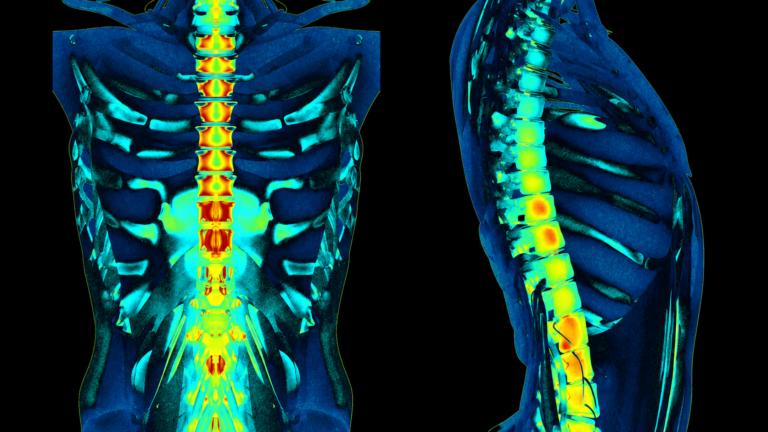
A spine MRI report lists what the scanner saw, not what is causing your pain. Many of the terms that worry patients, such as disc desiccation, disc bulge and loss of lordosis, are common in people with no pain at all. A finding matters when it matches your symptoms and your examination.
Your spine MRI report describes structure. It cannot tell you why you hurt. That needs your history and an examination.
Many of the patients I see in Pune arrive with the report folded in a bag and one phrase circled in pen. Some have been told their reedh ki haddi ghis gayi hai, that the spine is worn out. The report reads that way because radiologists are trained to record every change they see. Judging which one matters to you is a different job.
What your spine MRI report actually records:
The radiologist looks at each level of your spine and describes the discs, the small joints, the nerves and the spaces they travel through. Everything visible gets recorded, whether or not it is likely to cause symptoms. A normal, ageing spine can still produce a long report.
The radiologist usually hasn’t examined you, and may not know which leg hurts. So the report is a description. The meaning comes when someone puts it next to you.

Six terms that worry patients most:
These appear on most reports. The middle column is what the term describes. The last column is what it does not mean on its own.
| Finding | What it means | What it does not mean |
|---|---|---|
| Disc desiccation | The disc has lost some water and looks darker on the scan. An expected change with age. | That the disc has dried up or will collapse. Not a cause of pain by itself. |
| Disc bulge | The disc outline extends evenly past the vertebra around much of its edge. | A herniation or a “slipped” disc. Common without symptoms. |
| Disc protrusion / herniation | Disc material has moved beyond its normal boundary in one area. | Automatic nerve pressure or automatic surgery. Many shrink with time. |
| Annular fissure | A separation in the disc’s outer fibres, sometimes still called a “tear”. | An injury you caused, or a disc about to burst. |
| Neural foraminal narrowing | The opening where a nerve root leaves the spine is smaller than usual. | Nerve compression, unless your symptoms follow that nerve. |
| Loss of lordosis | The normal inward curve of the lower back or neck looks flatter. | A deformity. Often due to position in the scanner or muscle spasm. |
Foraminal narrowing matters only when the nerve at that level is the one producing your symptoms. If your pain is on the other side, or only in your back, it may be an incidental finding.
Why normal backs have abnormal scans
In 2015, a team at the Mayo Clinic pooled imaging studies of more than 3,000 people with no back pain. Disc degeneration appeared in 37% of 20-year-olds and 96% of 80-year-olds. Disc bulges rose from 30% to 84% across the same ages.
These people were not patients. They had no symptoms. Their scans would have produced reports very like the one you are holding.
That doesn’t make your findings irrelevant. It means a finding alone can’t settle the question. We don’t fully understand why two people with near-identical discs experience pain so differently. Nerve sensitivity, inflammation, load and sleep all seem to play a part, but the evidence isn’t definitive.
What connects a finding to your pain
The question I ask of every report is whether it agrees with the person in front of me. Each nerve root supplies a particular strip of skin and particular muscles. When your leg pain, numbness or weakness follows the path of the nerve the report describes, the finding carries weight. When it doesn’t, I look elsewhere: the hip, the sacroiliac joint, or muscle and load.
That’s why an L4-L5 disc protrusion can mean very different things for two people. For one, it explains everything. For the other, it’s background.
Some words on a report, though, do call for a quicker look.
Report terms that deserve a prompt review
Most findings can wait for a planned consultation. A few are different.
u003cemu003eSeeing these words is a reason for timely review, not a diagnosis.u003c/emu003e
- u003cstrongu003eu003cstrongu003eCord compression or cord signal changeu003c/strongu003eu003c/strongu003e
— the spinal cord itself needs assessment.
- u003cstrongu003eu003cstrongu003eCauda equina compressionu003c/strongu003eu003c/strongu003e
— pressure on the nerves that control bladder, bowel and leg function.
- u003cstrongu003eu003cstrongu003eFracture or marrow oedemau003c/strongu003eu003c/strongu003e
— a change in the bone whose cause needs identifying.
- u003cstrongu003eu003cstrongu003eLesion, mass or enhancementu003c/strongu003eu003c/strongu003e
— wording that asks for further evaluation.
These terms don’t always mean something serious. But they shouldn’t wait weeks for a routine appointment, particularly alongside new weakness or numbness.
How to bring your report to a consultation
Bring the images, not only the typed report: a CD, a film set or a download link. I read the images myself, and the report is only my starting point. Bring earlier scans if you have them. Change over time often tells me more than a single picture.
COMMON QUESTIONS
u003cstrongu003eMy report says “degenerative changes.” Is my spine getting worse?u003c/strongu003e
It means age-related change is visible. It isn’t a forecast. Many people carry the same findings for years without their symptoms changing, though no one can predict the course precisely for one person.
u003cstrongu003eShould I get a repeat MRI to see if it has improved?u003c/strongu003e
Usually not, unless your symptoms change or the result would alter a treatment decision. Symptoms can improve well before a scan does, and some disc herniations shrink over months.
u003cstrongu003eDoes a disc herniation on MRI mean I need surgery?u003c/strongu003e
No. Many cases of u003ca href=u0022https://drshrinathspine.com/disc-herniation/u0022u003eu003cuu003edisc herniationu003c/uu003eu003c/au003e settle with time and non-surgical care. Surgery is usually discussed when nerve symptoms persist despite that care, or when weakness is significant or getting worse.
When to see a doctor
fdgsdrhsthsftghgh
PLAN AN EVALUATION
- SDFSDFSDFds
SEEK URGENT CARE
- sDFDSfDSF